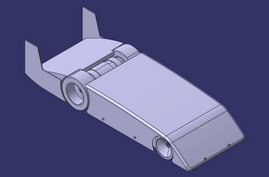
Pictures of the X2 progress in chronological order

Monday, September 3, 2007

Update: Modifications

I have been working on changing a couple things for the X2. Since I am driving the car backwards, the front steering (now the back) needs to be turned around to keep the correct steering geometry. I turned the steering around 180 degrees. I also got some trailing front axles to keep excessive twitching of the steering to a minimum. I also changed the caster to -4 degrees.

I got an Eagle Tree Micrologger data acquisition system. This plugs in-between the Thunder Power batteries and Castle HV-110 speed control and can accurately measure a multitude of things. Currently it is measuring battery voltage, current, watts, mAh used, motor rpm and will include the airspeed sensor in the future.

I am also working on machining wheels out of aluminum. As you can see from my previous tests, I am having a hard time keeping the foam on the standard plastic rims. I want to experiment with some machined rims and different foam types to see if I can make a wheel that will hold up to the extreme performance of these speeds.

I am also working on a setup to provide downforce on the front wheels. My lack of acceleration is due to the fact that the coefficient of friction is lower than I expected. One way to increase traction without changing foam compound and increasing the weight of the car is to increase the downforce.
Here is a shot of the front suspension. It has been reversed to obtain the correct geometry. I installed trailing axle steering blocks to minimize the steering reaction. I also removed 1 set of washer from underneath the suspension arm mounts to increase the rear ride height to approximately 8mm. The upper arm mount shims were moved to provide -4 degrees of caster.
This is the Eagle Tree data acquisition micrologger. This will help me accuratley monitor voltage, speed, motor rpm and amp draw.
This is a sample graph of what the Micrologger can do. This example was from a quick bench test to see if everything was working. The car was freewheeling on the car stand. There seems to be some noise in the data. The only time the wheels were running is when you can see the rpm move into the 2 "humps" on the bottom of the graph. I was throttling up slowly to neutral then slowing down again. I did this twice. The data right before and after These rpm "humps" shouldnt be there since the motor wasnt even rotating. This could be caused by cogging of the brushless motor. You can see the rpm shoots up to 50,000 then goes to 0, which shouldn't happen.
Wheels being machined

Saturday, August 18, 2007

New website

Updates on my car will continue to be at this website. The new website where I will keep all other fast RC cars will be at www.fastestrc.blogspot.com

I'm updating the site

I am going to make some big changes with my website. I started this website to keep a detailed record of all the fast RC car projects people are in progress. I also wanted to keep a detailed report of all the high speed events and have all that info in one place. But when I started on my project "X2" and detailing all of my progress, people were getting confused on who was making what car. For example, when Jalopnik reported on my car, they thought it was Nic Case who was making it:

Most full sized vehicles can't hit 200 mph, let alone radio controlled cars (in actual miles per hour, not scale). But Nic Case hopes his X2, currently in development, will do just that. Current holder of RC car speed record of 134.4 mph, Nic's goal is nevertheless an optimistic one. Powered by a 29.6 Volt direct drive motor, the X2's theoretical top speed is 274 mph, but that's without any drag generated by friction with the road or air. Special foam tires capable of withstanding the incredibly high RPMs keep the diminutive car in contact with the track, while a gyroscope manipulates rudders to automatically keep it in a straight line. A video of the X2 running shakedown tests follows the jump.

So after reading this, I am going to change the website to show just my updates for my car. I will move all the other posts to a new website.

Friday, August 3, 2007

The word is getting out


Caption for the video: For this test I designed a new body out of Lexan. For these tests I was running 8s Li-Po 3300 mah Thunder Power batteries and a NEU 2215/3Y ... all » motor direct drive. I was not getting any range with my Futaba 2.4 ghz 3PM transmitter (only 100ft) so I went back and used my very old Futaba 27 mhz 1024 PCM transmitter. I was able to get almost 900ft of range with my old controller.

The results of my testing showed that around 70-80mph my TMRC drag racing tires would catastrophically fail. They would explode leaving foam all over the track. The car was not damaged in any way.

Well, it looks like the word is spreading about my car and my attempt at 200mph with an rc car. This is great, except for all the wrong information that people have been posting. So far its been at:

Jalopnik

Digg

Autoblog

Engadget

OhGizmo

PistonHeads

Gizmodo

Almost all of the information is wrong in those posts so I will fix it here:

www.fastrc.blogspot.com is the website I started to follow the progress of all the high speed cars in the RC community. After months of reporting on other peoples cars, I decided to create my own high speed car. With my background in Aerospace Engineering I thought it would be a cool project.

The info in the post isn't correct, My name is Nick Maslowski and www.fastrc.blogspot.com is mine and the X2 is the car I designed and am testing now. Nic Case is the current record holder at 134.4 mph for an RC car. I just report on the high speed events and peoples cars, that is why he is on my website. His electrified nitro Associated TC3 went 134.4 mph at last years World Fastest RC car contest. This year he got 127.2 mph with an electrified Shumacher Fusion.

I use the website to post updates on my progress and post updates on other high speed contests. I started with the design phase on a CAD program called CATIA V5 (Boeing uses this program to design their planes, I work for Boeing as an aerospace engineer). I spent 6 months designing it, then 2 months ago I built it, and now I am testing the X2. My ultimate goal is to reach 200 mph by next years Worlds Fastest RC car contest held by RC Car Action magazine. What you see in that video is the first real ground test of the car. I had not gone above 30 mph before this video was shot. In that video I was able to get it up to around 80 mph. Then I had issues with the foam tires exploding due to the VHT on the surface and the coefficient of friction being very inconsistent. The car is still in the prototype stage. (you never see a new corvette being tested with a showroom floor finish, right? It always has a camo mask on and a lot of temporary aero pieces.) The whole car isn't finalized and is still subject to a lot of change before its final form. The guy taking the video is an older gentlemen and his health isn't the best. He is an expert in chassis design and suspension systems. He has helped me out a lot. The Houston raceway is the only place to open up a car like this. Its flat and I have plenty of room to wind it up and slow down.

I am working up to the cars full power from test to test. The average person doesn't know much about real RC cars and here is the info on this one: The finished power set-up will use a 12s (44v) Lithium Polymer battery from Thunder Power. The motor is a Neu brushless custom modified 2215/3y. It has a power capacity of 5000 watts (around 6.7 hp) and will be spinning the wheels at 21,000 rpms at 200 mph. The speed control is a Castle Creations HV-110 airplane controller. It can handle up to 44 volts and 110 amps continuous. No other RC car has this much power in such a small package.

If anyone else can build something faster, I'd love to see them try. Email me on my website at www.fastrc.blogspot.com about your try at these high speeds.

-Nick M.

Tuesday, July 24, 2007

Video "X2" Update: Testing at Houston Raceway drag strip


Here is some video of when we first arrived at the drag strip. I start by slowly increasing my speeds on each pass. On the last pass you can hear buzzing as the car goes by. The buzzing sound is caused by the wheels becoming unbalanced as they lose more and more foam. In the pictures below you can see tire chunking. Top speed in this video was about 70 mph. Another thing to point out is how quiet the car is. Since this car has no gears or transmission, the only thing you really hear is the motor whine as the brakes are applied or if the chassis scrapes the ground. On faster runs all you can hear is the disturbed air as the car blows by. Around 3:10 is the fastest pass.
"X2" ready to get started.
I made a new Lexan body to conform with the car driving backwards. On my previous test runs I found out that driving with the motor in front and drive wheels in front greatly improved stability. On the left is my old Futaba 1024 27 mhz PCM transmitter that yielded about 4x better range than my brand new Futaba 2.4 ghz 3PM.
One set of tires blown up.
Another set of tires blown up.
Tire carnage from a day of high speed testing. I went through 4 sets of tires today. All had the same problem of self destructing. The adhesive between the rim and tire could not hold everything together.
My max speed out of these tests was about 70-80mph. We were also using a radar gun to measure speed and it closely matched my on-board speed meter.

I was able to get permission to test at the Houston Raceway. Its a full scale 1/4 mile drag strip on the east side of Houston in Baytown Texas. For this test I designed a new body out of Lexan. I was running 8s Li-Po 3300 mah Thunder Power batteries and a NEU 2215/3Y motor direct drive. I was not getting any range with my Futaba 2.4 ghz 3PM transmitter (only 100ft) so I went back and used my very old Futaba 27 mhz 1024 PCM transmitter. I was able to get almost 900ft of range with this old controller.

The results of my testing showed that around 70-80mph my TMRC drag racing tires would catastrophically fail. I would hear a very loud "crack" or "pop" as they would explode leaving foam all over the track. The car was not damaged in any way and was still very controllable even after tire failure.

After testing, I checked TMRC's website and it says that these tires have gone 107mph on nitro drag cars. I called and they said that other racers have encountered the same problem I have. They basically said that the tires might be hopping off the ground and free-wheeling for a split second. This causes the RPM's to go way up and the tires can fly apart. I will have to go back and try different spring and dampening combinations to minimize my wheel hop.